
Reviewed by Dr Kolade Orungbemi, Principal Dentist at Globe Dental Practice | Published 17 March 2026
Most people come to this decision after losing a tooth – or several – and feeling quietly overwhelmed. The internet tells you implants are the gold standard. Your mate says dentures are fine. Your budget says something else entirely. And somewhere in the middle of all that noise, you’re just trying to work out what’s going to feel normal again.
So let’s talk through the dental implants vs dentures question honestly. No pressure, no agenda – just the things worth knowing before you sit down with a dentist.
Dental Implants vs Dentures: The Core Difference
These are fundamentally different solutions. Worth being clear on that before anything else.
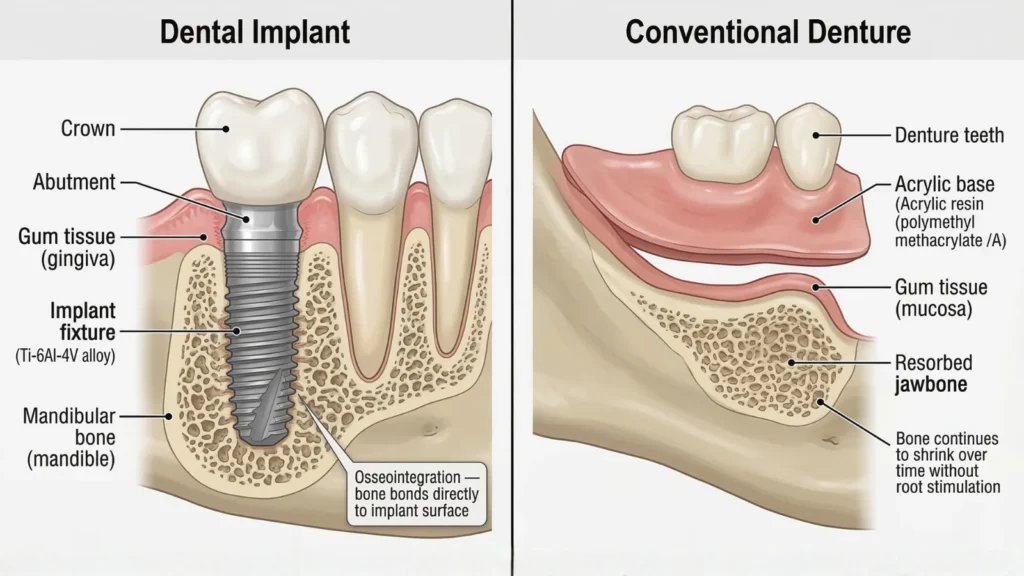
Dentures sit on top of your gums. They’re removable, they rest on bone and soft tissue, and they’ve been around in various forms for centuries. Modern dentures are far better than they used to be – but they’re still a surface-level fix, in a very literal sense.
Dental Implants go into the bone. A titanium post is placed surgically into your jaw, and over three to six months it fuses with the bone in a process called osseointegration. Once that’s done, a crown, bridge, or even a full arch of teeth gets attached on top. The result functions more like a natural tooth than anything else we currently have.
That difference – bone-level versus surface-level – is what drives almost everything else: the feel, the function, the longevity, and the cost.
The Honest Pros and Cons of Dental Implants vs Dentures
What implants do well
Implants preserve bone. This matters more than most people realise. When a tooth root is gone, the jaw bone underneath starts to resorb – it essentially shrinks because it’s not being stimulated anymore. Dentures don’t stop that process. Implants do, because the titanium post acts like a tooth root.
They also restore bite force much more effectively. Traditional dentures give you roughly 25% of your natural bite force. Implants get you to around 90-95%. That’s the difference between eating whatever you like and quietly avoiding certain foods.
Maintenance is simple – brush and floss them like natural teeth. No overnight soaking, no adhesive, no taking them out.
And they last. With decent oral hygiene, implants last 15–25 years or more. Some people have them for life.
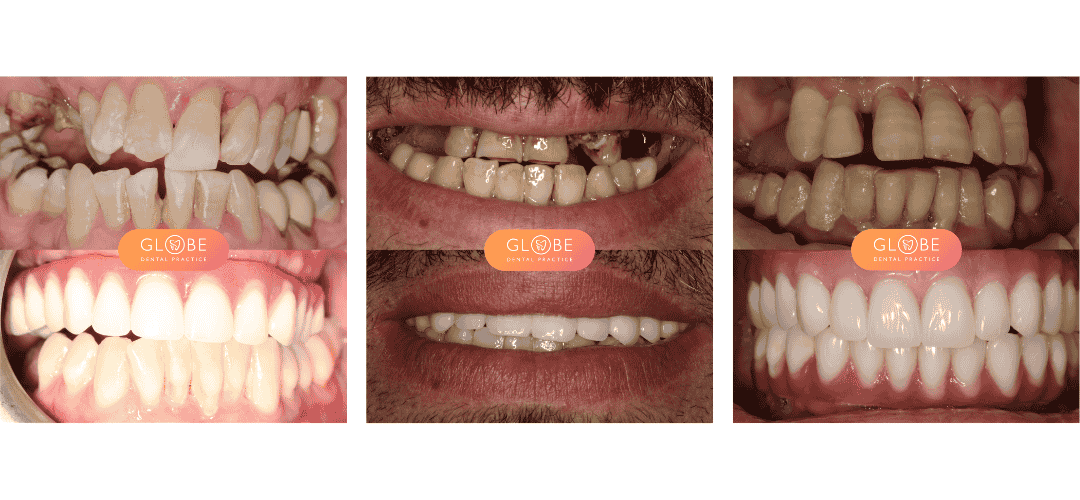
Real patient transformations using implants at Globe Dental Practice
Where implants fall short
They require surgery. That’s not something to gloss over. It’s a real procedure, done under local anaesthetic, and the full process from assessment to final crown takes four to six months. Some people need a bone graft first if there’s been significant bone loss, which adds cost – typically £400-£800 – and time.
The upfront cost is significant, and we won’t pretend otherwise.
A single implant in the UK runs from around £1,800 to £4,200. That typically covers the consultation, CBCT imaging, treatment planning, the implant placement itself, the abutment, and the final crown – though it’s always worth confirming exactly what’s included when you get a quote, as practices vary.
A full arch using the All-on-4 technique starts at around £13,000. NHS implant treatment is almost never available – it’s reserved for exceptional medical circumstances – so for the vast majority of patients, this is private treatment territory.
What dentures do well
They’re accessible. NHS dentures cost £326.70 under Band 3 treatment (as of April 2025). Private dentures range from £700 to £3,000 or more depending on materials and complexity. For patients on a tight budget, or those who genuinely can’t undergo surgery due to health reasons, dentures remain a valid and practical option.
Non-invasive, too. No surgery, no healing period, no waiting months to see the result. There’s an adjustment period – usually two to four weeks while you adapt – but the process is relatively quick compared to implants.
They can also work well for patients with significant bone loss who may not be suitable for implants without extensive grafting.
Where dentures fall short
The bone resorption issue doesn’t go away. As your jaw changes shape over time, dentures that once fitted well start to feel loose – which means regular adjustments and eventual replacement, typically every five to eight years.
And then there’s the practical reality of living with removable teeth. Some people adapt completely and barely think about it. Others find the daily routine – removal, cleaning, adhesive – genuinely disruptive to their confidence and quality of life. Both responses are completely normal. It really does vary.
The Middle Ground: Implant-Retained Dentures
This option doesn’t get talked about enough.
Implant-retained dentures (sometimes called “denture implants” or snap-on dentures) use two to six implants as anchor points to stabilise a denture. The denture itself is still removable – you take it out to clean it – but it clips onto the implants rather than resting loosely on the gums.
Far better stability than traditional dentures. Lower cost and less surgical complexity than a full implant restoration. Costs in the UK typically run from £8,000 to £18,000 per arch depending on the design and number of implants involved.
For patients with moderate bone loss who want something more secure than a conventional denture but aren’t ready for – or can’t afford – full implant treatment, this is often the most sensible route. You can read more about denture options at Globe if you want to understand what’s involved before coming in to talk it through.
Cost of Dental Implants vs Dentures in the UK
Here’s a clear breakdown:
| Treatment | NHS | Private |
|---|---|---|
| Traditional dentures | £326.70 | £700–£3,000+ |
| Single implant | Rarely available | £1,800–£4,200 |
| Full arch implants (All-on-4) | Not available | £13,000–£18,000 |
| Implant-retained dentures | Not available | £8,000–£20,000 |
The cost gap is real and it’s large.
But implants are a one-time investment for most people. Dentures need replacing every five to eight years, and each replacement has a cost. Over a 20-year period, the gap between the two options narrows considerably – especially for younger patients.
Most private practices also offer payment plans and 0% finance, which makes implant treatment more manageable month-to-month even if the headline figure looks daunting.
So Which Is Right for You?
Honestly? It comes down to three things more than anything else: your bone density, your budget, and your health.
Good bone density, reasonable health, and the ability to plan for the cost – implants are the better long-term solution for most people. They function better, last longer, and preserve your jaw.
But if budget is the primary constraint, or if you have significant bone loss, or if surgery isn’t an option for medical reasons – dentures are not a failure. They’re a legitimate treatment that millions of people live with perfectly well.
And if you’re somewhere in the middle, implant-retained dentures are worth a proper conversation. They’re the option that often gets overlooked, and for the right patient, they hit a genuinely useful sweet spot.
The only way to know for certain is a proper clinical assessment – CBCT (3D) imaging to evaluate your bone density and volume, a bite analysis, soft tissue evaluation, and a thorough review of your medical and dental history. That’s what should happen before anyone starts talking about treatment plans.
Please note: This article is for general information only and does not constitute clinical advice. Everyone’s dental situation is different, and the right treatment for you depends on your individual bone density, health history, and clinical assessment. Please consult a qualified dental professional before making any decisions about tooth replacement.
Talk It Through With Globe

If you’re weighing up your options and want a clear, honest conversation – not a sales pitch – Globe Dental Practice offers implant consultations with full clinical assessment. This includes CBCT imaging and Digital Smile Design (DSD) planning where appropriate.
Dr Kolade and Dr Yetunde Orungbemi are both experienced in implant dentistry and see NHS and private patients at their practice in the heart of Nantwich.
We’re at 53 Beam Street, Nantwich, Cheshire. You can call us on 01270 625 069 to book a consultation, or just to ask a question before you commit to anything.