
Reviewed by Dr Kolade Orungbemi, Principal Dentist at Globe Dental Practice | Published 17 March 2026
Full mouth dental implants are one of the most significant investments a person can make in their health. And if you’ve started researching, you’ve probably already noticed that the cost varies wildly depending on where you look, who you ask, and which technique is involved. That variation isn’t random – but it can feel baffling when you’re trying to make a sensible decision.
This post breaks down what you’d actually pay, what drives the price differences, and what the whole process looks like from a patient’s perspective. No fluff, no scare tactics.
What Does Full Mouth Dental Implants Cost Actually Look Like in the UK?
Here’s the honest answer: for most people replacing all their teeth with fixed implants, you’re looking at somewhere between £20,000 and £40,000 for both arches in 2026. That’s a wide range, and there are legitimate reasons for it.
Per arch (upper or lower jaw only), the typical range runs from around £10,000 to £25,000, depending on the technique and clinic.
Those numbers might feel shocking. But it helps to understand what’s actually included, and why dental implants cost what they do.
NHS or Private: What Are Your Options?
Full mouth dental implants are not available on the NHS for most patients. Not because the NHS doesn’t recognise them as effective (they do). It’s because the cost is simply too high to fund routinely. NHS dental provision is prioritised for urgent and essential care, and full implant rehabilitation sits outside that scope for the vast majority of people.
There are rare exceptions. Patients who’ve lost teeth as a direct result of cancer treatment may be referred through specialist NHS pathways. But these cases are genuinely uncommon, waiting times are long, often 12 to 18 months or more for any complex restorative work, and the criteria are strict.
For everyone else, this is a private treatment.
If you can’t afford implants right now, the NHS can provide dentures. They work. They’re not the same. We’ll come back to that comparison, but they are a legitimate option while you save or research finance.
The Main Techniques and What They Cost
The phrase “full mouth dental implants” actually covers a few different approaches. The one that’s right for you depends on your bone density, how many teeth you’re missing, your overall health, and what you want the end result to feel like.
All-on-4 Dental Implants
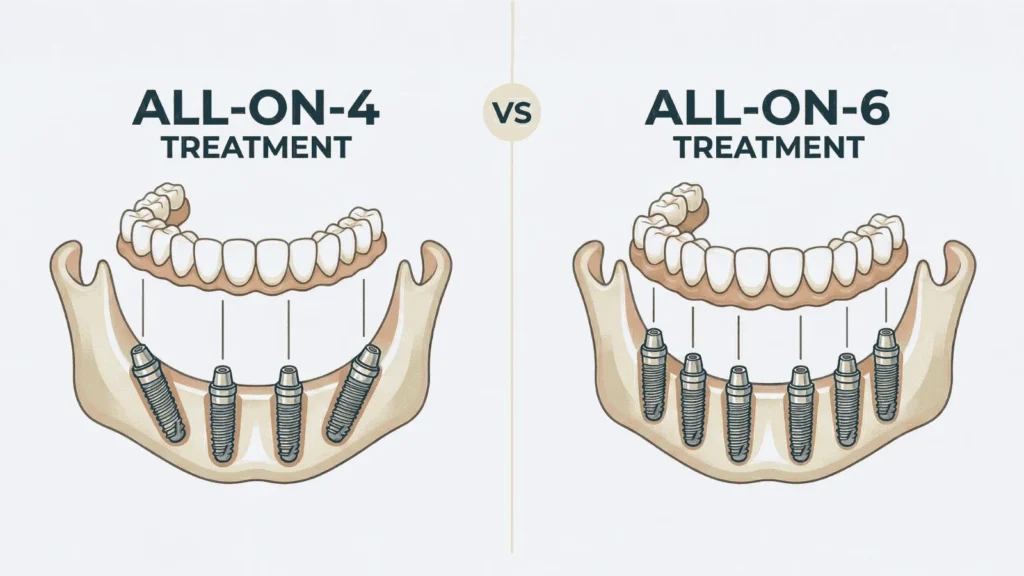
All-on-4 is the most widely offered technique for full arch replacement in the UK right now. The name tells you the structure: four titanium implants per arch, positioned at carefully planned angles – which vary depending on your individual anatomy – to maximise contact with available bone. A fixed bridge is then attached to those four points.
The All-on-4 dental implants cost in the UK currently sits at around £10,000 to £18,000 per arch, with some clinics advertising from £9,995. For both arches, you’re typically looking at £20,000 to £35,000 all in – though premium clinics in London push well beyond that.
One of the genuine advantages of All-on-4 is that the angled implant placement often means bone grafting isn’t needed, even in patients with some degree of bone loss. That matters because grafting adds both cost and time. Same-day teeth – where a temporary fixed bridge is fitted on the day of surgery – are common with All-on-4, which is a big part of why it’s become so popular.
All-on-6
All-on-6 uses six implants per arch instead of four, distributing the load more evenly. Some clinicians prefer it for patients with sufficient bone who want greater long-term stability.
All-on-4 dental implants UK price comparisons with All-on-6 typically show a gap of a few thousand pounds per arch. All-on-6 usually runs from around £14,000 to £20,000 per arch, so £28,000 to £40,000 for both.
Whether the extra implants are worth it is a clinical question, not a marketing one. Your dentist should be able to explain their reasoning clearly – and if they can’t, that tells you something.
Read our full comparison guide for All-on-4 vs All-on-6
Traditional Full Mouth Implants (6–8 per arch)
The traditional approach uses more implants – typically six to eight per arch – each supporting an individual crown or a smaller bridge section. This is the most tooth-like result in terms of how forces are distributed, but it’s also the most expensive and requires the most bone.
Costs here can run from £15,000 to £35,000 per arch, meaning full mouth restoration through this route can reach £25,000 to £70,000 depending on complexity and materials. Most patients researching full mouth implants aren’t starting with this option, but it exists and it’s worth knowing about.
Implant-Retained Dentures
Worth mentioning separately: implant-retained dentures use two to four implants to anchor a removable denture in place, rather than supporting a fixed bridge. Significantly cheaper – from around £5,600 per arch – and a good solution for some patients. But they’re not the same as fixed implants. The denture still comes out for cleaning, and it doesn’t replicate the feel of permanent teeth in the same way.
What Pushes the Price Up (or Down)?
The range in full mouth dental implants cost isn’t arbitrary. Several real factors affect what you’ll pay.
Bone grafting. If you’ve had missing teeth for a while, the bone underneath may have resorbed. Grafting is sometimes needed to create enough volume for implants to anchor into. This adds £500 to £2,000 depending on the extent of the work.
Implant brand. There’s a meaningful difference between established implant systems – Nobel Biocare, Straumann, Osstem – and cheaper alternatives. Branded implants typically add £500 to £1,000 per implant to the cost, but they come with decades of clinical data behind them.
The prosthesis material. The bridge or crown attached to your implants can be made from different materials. Zirconia – a high-strength ceramic – looks excellent and is highly durable, but upgrading from acrylic to zirconia can add £2,000 to £5,000 to the overall cost.
Location. Clinics in London charge significantly more than those elsewhere in the UK. A single implant in London might cost £2,500 to £5,500; the same implant in Cheshire might be £1,500 to £2,000. For full mouth work, that regional difference compounds considerably.
The clinic itself. An experienced implant dentist with a dedicated team, digital planning tools, and in-house technology will charge more than a clinic without those things. That’s usually a reasonable reflection of quality – not just overhead.
What the Process Actually Involves
People sometimes focus so much on cost that they don’t get a clear picture of what treatment actually entails.
It starts with a thorough assessment – CBCT (3D) imaging to map your bone density and volume, a bite analysis, soft tissue evaluation, and a detailed review of your medical and dental history. If Digital Smile Design (DSD) planning is appropriate for your case, this is also done at this stage. This is where a good dentist will tell you honestly whether implants are suitable for you. This is where a good dentist will tell you honestly whether implants are suitable for you. Not every patient is a candidate, and a clinic that tells everyone they’re suitable isn’t doing its job.
If you’re going ahead, the surgical day involves placing the implants into the jawbone under local anaesthetic, with sedation available. Each arch takes roughly one to three hours. A temporary prosthesis – fixed or removable depending on the approach – is typically fitted the same day or shortly after.
Then comes the healing period. The implants need to fuse with the bone – a process called osseointegration – which takes three to six months. During this time you’ll be on a soft diet and attending follow-up appointments.
Once healing is confirmed, your permanent bridge or prosthesis is fitted. With All-on-4, the whole process from surgery to final teeth typically runs four to six months. Traditional approaches can take six to twelve months.
Recovery after surgery involves swelling and bruising for around seven to ten days. Most people manage this with over-the-counter pain relief and rest. It’s not painless – we won’t pretend otherwise – but patients consistently describe it as more manageable than they expected.
Are Full Mouth Implants Worth It?
Direct answer: for most people, yes.
Implants last. With proper care, All-on-4 and All-on-6 systems have success rates of 95 to 98% over ten years, and well-maintained implants last 20 to 25 years or more. Conventional dentures typically need replacing every five to seven years, and that cost adds up. Implants also preserve the jawbone – dentures don’t – which matters for your facial structure over time.
Around 90 to 95% of patients who undergo full mouth implant treatment report a significant improvement in quality of life: better chewing, clearer speech, and confidence that removable dentures simply can’t match.

That’s not a sales pitch. It’s what the clinical evidence consistently shows.
But implants aren’t right for everyone. Certain health conditions, medications, and bone loss scenarios affect suitability. The only way to know whether you’re a candidate is a proper clinical assessment – there’s no shortcut around that.
Finance Options
We won’t pretend the cost isn’t significant. It is. And for many people it’s a real barrier.
Most private implant clinics offer finance. Monthly payments for full mouth treatment typically start around £121 to £217 per month on a spread payment plan, though the total interest paid depends on the term and rate. Read the terms carefully and understand the full cost over the repayment period – not just the monthly number.
Some practices offer interest-free options for shorter terms. Ask directly. A transparent clinic will give you the numbers without pressure.
A Note on Going Abroad
It comes up in every conversation about implant costs. Turkey, Hungary, Spain – prices can be significantly lower.
It’s not necessarily dangerous. Many overseas clinics are skilled and well-equipped. But if something goes wrong – an implant fails, the fit is off, there’s an infection – you’re managing that complication with a dentist who has no relationship with the original team and possibly no access to your records. UK dentists see remedial work for failed overseas implants regularly. It’s expensive and often complicated.
That’s not a reason to rule it out entirely. It’s a reason to go in with your eyes open and ask very specific questions about what happens if things don’t go to plan.
Medical disclaimer: The information in this article is intended for general educational purposes only and does not constitute dental or medical advice. Individual circumstances vary significantly, and only a qualified dental professional can assess your suitability for implant treatment following a full clinical examination. Always seek advice from a registered dentist before making decisions about dental treatment.
Thinking About Implants? Here’s a Sensible Next Step
If you’re based in Cheshire and want to talk through your options with someone who’ll give you a straight answer, Globe Dental Practice in Nantwich offers implant consultations without the hard sell.
Dr Kolade Orungbemi and Dr Yetunde Orungbemi run an independent family practice – not a corporate chain – and they treat patients as people who deserve clear information, not a sales funnel. You can see the full range of treatments they offer here.
Globe Dental Practice is at 53 Beam Street, Nantwich, Cheshire. You can call them on 01270 625 069 to ask questions or book a consultation.