
Reviewed by Dr Kolade Orungbemi, Principal Dentist at Globe Dental Practice | Published 30 March 2026
There’s questions almost everyone asks before committing to dental implants: how long do dental implants last, really? How long does a tooth implant last before it needs replacing? Not the optimistic version. The honest one. Because implants aren’t cheap, and you want to know what you’re actually getting for your money before you sit in that chair.
So here it is, plainly.
The titanium post that goes into your jawbone can last a lifetime – literally decades, potentially 30 or 40 years, sometimes longer. A 2025 study found implants still functioning well after 40 years with minimal bone loss. The crown on top – the visible tooth part – typically needs replacing after 10 to 15 years due to everyday wear. That’s not a failure. That’s just how it works.
Understanding that distinction is the whole key to understanding implants.
How Long Do Dental Implants Last? The Two-Part Answer
An implant isn’t one thing. It’s a system, and each part ages differently.
The titanium post is surgically placed into your jawbone, where it fuses with the bone through a process called osseointegration. Once that fusion is complete, the post becomes extraordinarily stable. Titanium is biocompatible, resistant to corrosion, and remarkably durable under pressure. It’s designed to last indefinitely. Most clinical data puts titanium implant lifespan at 20 to 25 years or more, and the long-term evidence increasingly suggests that “lifetime” isn’t an exaggeration for most patients.
The crown – the porcelain or ceramic tooth that sits on top – is a different story. It takes the daily battering of chewing, grinding, and general use. Most crowns last 10 to 15 years before they need replacing. Some last longer with good care. Some need attention sooner if you grind your teeth or have habits that accelerate wear.
The abutment – the small connector piece between post and crown is generally very durable, though it can occasionally work loose and need adjustment.
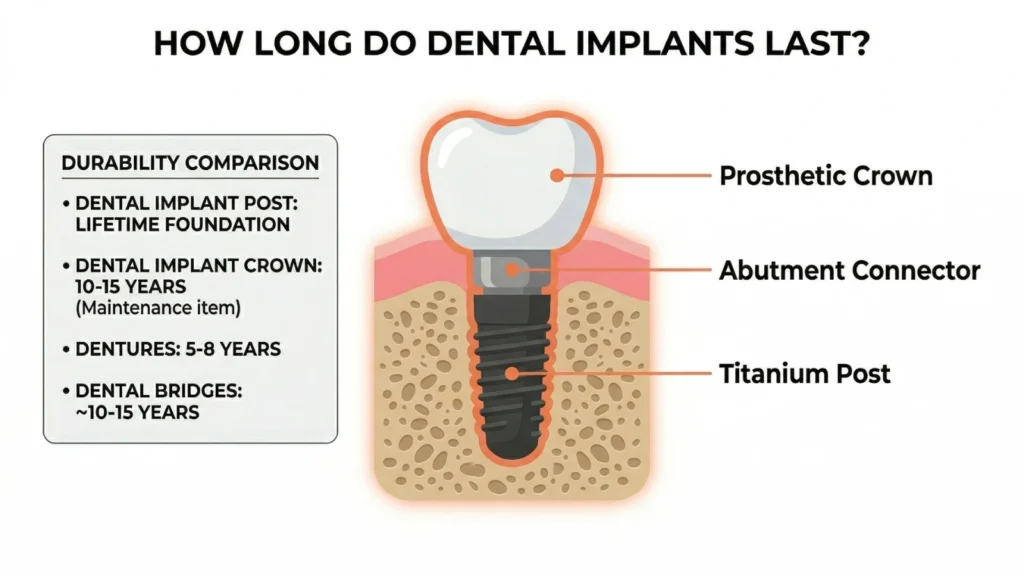
So are dental implants permanent? Mostly, yes. The foundation is as permanent as dentistry gets. The visible tooth on top needs occasional maintenance over the decades. That’s a very different thing from dentures, which typically need replacing every 5 to 8 years, or bridges, which average around 10 to 15 years before significant issues arise.
What Actually Determines How Long Your Implant Lasts
The 95 to 98% ten-year success rate for dental implants in the UK is impressive. Put another way, the dental implant failure rate in the UK sits at roughly 2 to 5% over ten years – one of the lowest of any surgical implant. But it’s an average. Your individual result depends on several things that are very much within your control – and a few that aren’t.
Oral hygiene
This is the big one. Implants can’t get cavities, but the gum tissue and bone around them absolutely can be damaged by bacteria. Peri-implantitis – an infection around the implant – is one of the main causes of implant failure. It’s essentially gum disease affecting an implant site, and it can erode the bone that’s holding everything in place. We see patients who’ve had beautiful implant work elsewhere come unstuck at this stage, not because the placement was wrong, but because the maintenance slipped.
Dental implant maintenance isn’t complicated, but it’s non-negotiable. Daily brushing and flossing, plus regular professional hygiene appointments, aren’t optional extras.

Bone density and overall health
The implant needs healthy bone to fuse with. If your bone density is low – whether from age, previous tooth loss, or other factors – the osseointegration process is harder, and the long-term stability is less certain. This is why a proper assessment with 3D CBCT imaging is essential.
Smoking significantly increases failure risk. So does poorly controlled diabetes. Neither is an absolute barrier to implants, but both need to be part of the conversation with your dentist.
Where the implant is
Front teeth have an easier life than back teeth. Your molars bear the brunt of chewing forces – we’re talking hundreds of pounds of pressure per square inch. Implants at the back of the mouth face more mechanical stress and have slightly lower long-term success rates than those at the front. Not dramatically lower. But worth knowing.
Bruxism (teeth grinding)
If you grind your teeth at night, it accelerates wear on the crown and puts repeated stress on the implant system. A night guard can protect both your natural teeth and your implants. If you know you grind, this conversation needs to happen before treatment begins.
The quality of the placement
An implant placed well, at the right angle, with appropriate bone preparation, in a clinic with proper diagnostic equipment, will outperform one that wasn’t. This isn’t about being snobbish about dentists. It’s just physics.
All-on-4 Implants: Does the Lifespan Differ?
All-on-4 (sometimes called All-on-X) uses four strategically placed implants to support a full arch of teeth. It’s a completely different treatment to single implants in scope, but the longevity data tells a similar story.
The implant posts themselves follow the same principles — titanium fusing with bone, designed for decades of function. The prosthetic arch on top will need maintenance and eventual replacement, much like individual crowns do. The 10-year survival rates for All-on-4 are consistently above 95% in the literature, which aligns with single implant data.
For a full comparison of two approaches, see our guide to All-on-4 vs All-on-6 dental implants.
What changes with All-on-4 is the complexity of maintenance. Cleaning under a fixed arch requires specific tools and technique. Regular professional hygiene appointments become even more important. Where indicated, Digital Smile Design (DSD) technology can also be used during the planning stage to visualise the final aesthetic outcome before treatment begins. But for patients who’ve struggled with failing teeth or ill-fitting dentures, the functional improvement is enormous – and it holds up for decades when properly maintained.
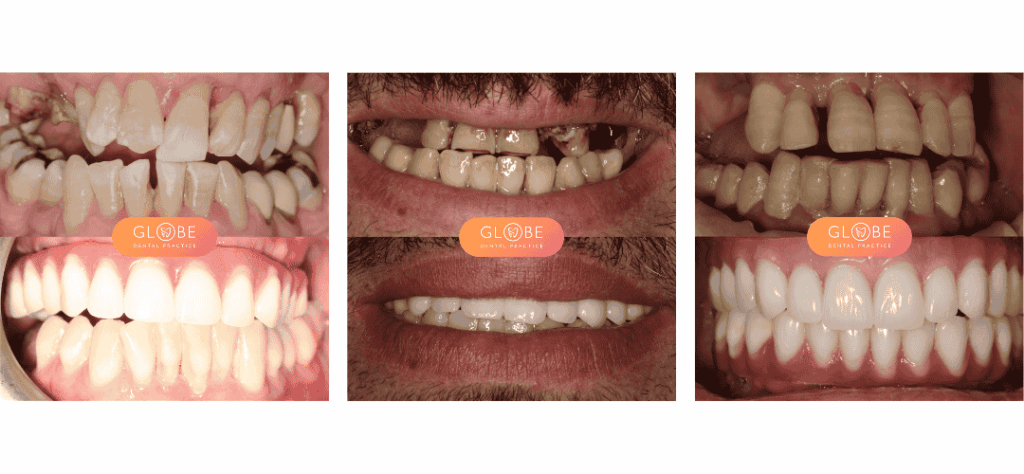
Real All-on-4 Implant transformations at Globe Dental Practice, Nantwich
What the Procedure Actually Involves
People often have vague anxiety about implants without knowing what they’re actually anxious about. Understandable – “surgery” is a word that does a lot of work. Here’s what the process looks like in practice.
It starts with a thorough assessment – 3D CBCT imaging to check bone volume and density, a bite analysis, soft tissue evaluation, and a full review of your medical and dental history.
The implant post is placed under local anaesthetic – typically 10 to 20 minutes per implant in straightforward cases, or 30 minutes to an hour in more complex situations. Most patients describe the experience as less uncomfortable than they expected. There’s pressure, but not significant pain during the procedure. Mild swelling and soreness for a week or two afterwards is normal.
Then comes the waiting. Osseointegration – the bone fusing around the post – takes 3 to 6 months. You can’t rush it. Once that’s complete, the abutment and crown are fitted. Start to finish, the full process typically takes 6 to 9 months, longer if a bone graft is needed.
It’s not quick. But the result is a tooth that functions like a natural one and, with proper care, should still be there in 20 years.

What It Costs in the UK
We won’t pretend the cost isn’t significant. Private single implants in the UK typically run from £2,000 to £4,000, depending on the clinic, location, and complexity. Full-arch All-on-4 treatment ranges from around £12,000 to £20,000 per arch. These fees typically cover diagnostic imaging, digital treatment planning, the implant system itself, laboratory fabrication of the crown, and your aftercare programme.
NHS coverage for implants is limited to specific clinical situations – congenital defects, certain medical cases – and waiting lists where it is available can stretch to a year or two. For the vast majority of patients, implants are a private treatment.
We’ve written a separate guide on whether you can get dental implants on the NHS if you want to understand the eligibility criteria in detail.
But measured across 20 or 25 years – against the repeated cost of replacing dentures or bridges, and the bone loss that comes with not replacing missing teeth at all – implants are often the more economical choice in the long run.
Medical disclaimer: This article is intended for general information purposes only and does not constitute clinical advice. Dental implant suitability, longevity, and outcomes vary between individuals. Please consult a qualified dental professional for a personalised assessment before making any treatment decisions.
Thinking About Implants? Here’s a Sensible Next Step
If you’re weighing up whether implants are right for you – or just want a proper conversation with someone who’ll give you a straight answer rather than a sales pitch – Globe Dental Practice in Nantwich is worth a call.
Dr Kolade and Dr Yetunde Orungbemi run an independent family practice at 53 Beam Street, Nantwich, Cheshire. They offer dental implants and full-arch All-on-X treatment, and they treat both NHS and private patients. No pressure, no corporate script – just honest advice about what’s likely to work for you.
Call the practice on 01270 625 069 to arrange a consultation.