
Reviewed by Dr Kolade Orungbemi, Principal Dentist at Globe Dental Practice | Published 30 March 2026
Most people searching for single tooth implant cost UK information have already made a mental leap. They’re not wondering whether an implant is the right answer they’ve probably already decided it is. What they actually want to know is: how much is this going to cost me, what am I actually paying for, and is it worth it?
So let’s get into it properly.
Single Tooth Implant Cost UK: What You’re Actually Looking At
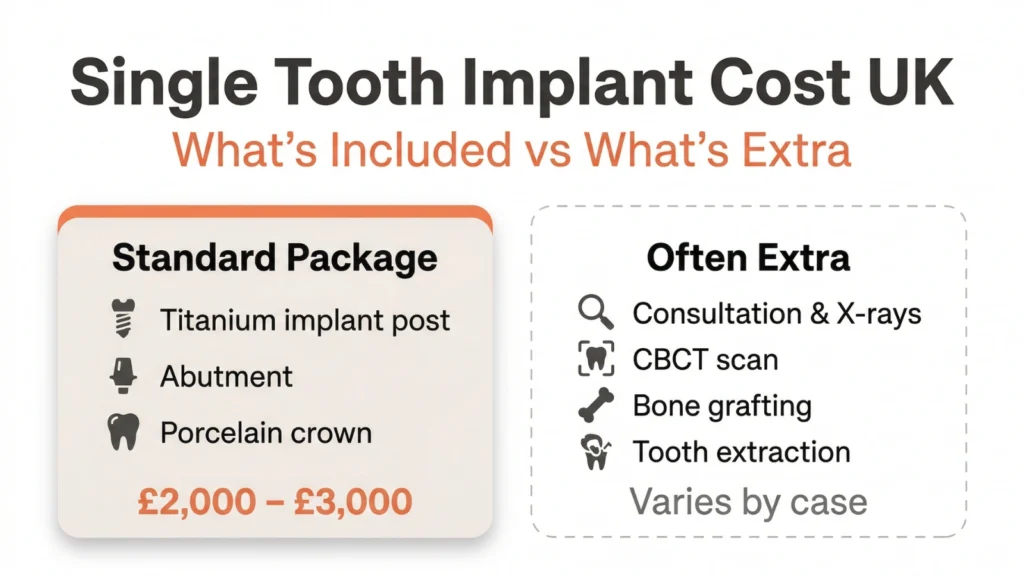
The honest answer is £2,000-£3,000 for a single tooth implant at most private practices across the UK. In London you’ll typically pay more, £2,500-£3,500 is common. Outside the capital, and particularly in areas like Cheshire, you’ll usually sit at the lower end of that range.
That’s the headline figure. But it’s rarely the whole story.
A standard single implant package covers three things: the titanium post that goes into your jawbone, the abutment (a small connector piece), and the crown which is the visible replacement tooth on top. What it often doesn’t include is the consultation, imaging, or any preparatory work you might need beforehand. This catches people off guard more than anything else.
At most practices, this fee also covers the surgical placement, any necessary follow-up appointments, and basic aftercare. At Globe, the implant fee covers the surgical placement, the implant system, laboratory fabrication of the crown, and your aftercare programme. CBCT scans and X-rays are normally charged separately unless included as part of an agreed treatment package – so it’s worth clarifying this upfront during your consultation.
Here’s what those extras typically cost:
- Consultation, examination and X-rays: around £95
- CT scan (needed for accurate implant planning): £150-£350
- Bone grafting, if your jawbone needs building up: add £1,000-£2,500
- Tooth extraction, if the original tooth is still present: variable
So if you need a CT scan and a bone graft, your total could realistically be £3,500-£5,500. Most patients don’t need bone grafting but some do, and it’s better to know that upfront than be surprised halfway through treatment.
What About the NHS?
Technically, NHS dental implants exist. The Band 3 charge is £326.70.
But in practice, NHS implants are vanishingly rare. The NHS classifies implants as cosmetic treatment, so funding is only approved in specific clinical circumstances such as facial trauma from an accident, cancer treatment affecting the jaw, certain congenital conditions, or a medically documented inability to wear conventional dentures. Missing a tooth from decay or an extraction almost certainly won’t qualify.
And even if you do qualify, you’re looking at an 18-24 month wait.
For the vast majority of people, a dental implant is a private treatment. That’s just the reality.
The Single Tooth Implant Procedure: What Actually Happens
This is the bit most cost articles skip over and it matters, because the timeline affects everything from how you plan your diary to how you budget across the year.
Stage one: assessment
That means a 3D CBCT scan of your jaw, a bite analysis, soft tissue evaluation, and a thorough review of your medical and dental history – not just a quick look and an X-ray. If there’s active gum disease, that has to be treated first. Placing an implant into an unhealthy mouth is one of the more reliable ways to make it fail.
Stage two: placement
The implant post is a small titanium screw, typically 3–4mm in diameter, placed into the jawbone under local anaesthetic. The exact position, angle, and depth are planned digitally beforehand based on your specific bone anatomy – this isn’t a one-size-fits-all procedure. Most patients find this less uncomfortable than they expected. The gum is stitched closed over the top, and then you wait.
Stage three: osseointegration
This is the quiet bit. Over the next three to six months, your jawbone fuses with the titanium post in a process called osseointegration. Not painful. You’re just waiting for biology to do its thing, the implant becomes structurally part of your jaw.
Stage four: the crown
Once the implant has integrated, the abutment is attached and a crown is fitted on top. The crown is colour-matched to your surrounding teeth. Nobody should be able to tell the difference.
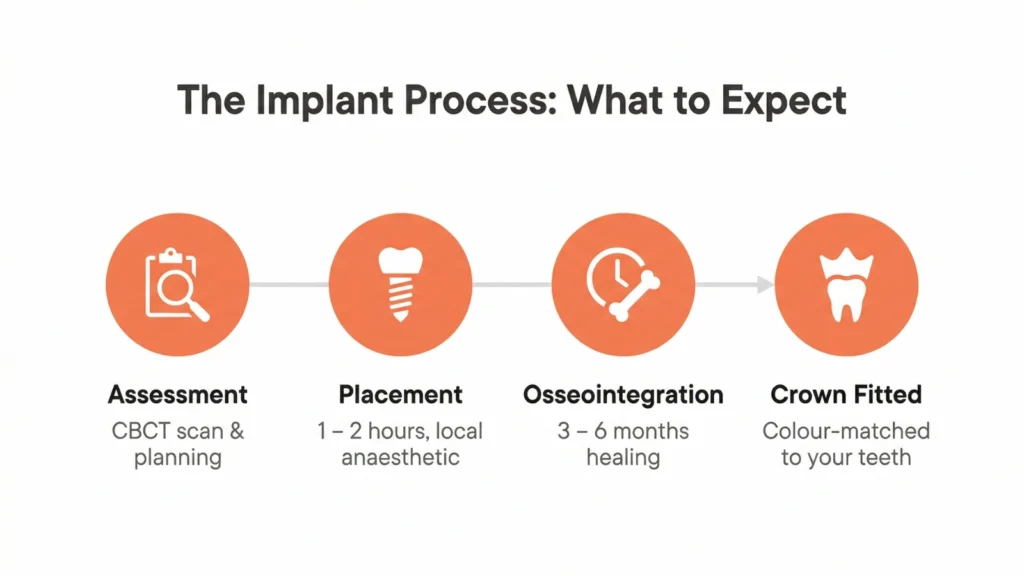
Start to finish, you’re usually looking at six to nine months. Some cases move faster. Some, where bone grafting is involved, take longer.
Single Tooth Implant vs Bridge: The Honest Comparison
A dental bridge is the main alternative. Worth being direct about the trade-offs.
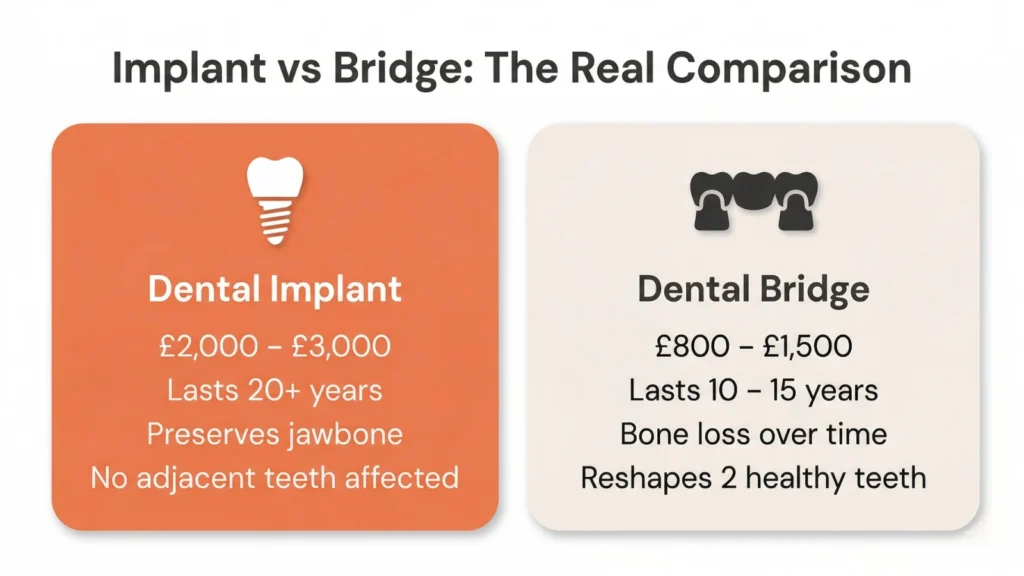
A bridge is cheaper upfront, typically £800-£1,500 for a three-unit bridge. It replaces the missing tooth by crowning the two teeth on either side and suspending a false tooth between them. It looks good and works well.
But there are real downsides. To fit a bridge, your dentist has to permanently reshape two healthy teeth that were perfectly fine before. Those teeth are now crowned for life, which means more dental work down the line if anything goes wrong with them. Bridges also typically last 10-15 years before needing replacement.
Implants don’t touch adjacent teeth. They also preserve the jawbone underneath. When a tooth root is lost, the bone in that area gradually shrinks, which can change the shape of your face over time. An implant post stimulates the bone just like a natural root does, so that doesn’t happen. It’s one of those things patients often don’t think about until we mention it.
A well-maintained implant lasts 20, 30 years or more. Some last a lifetime.
The implant costs more now. The bridge costs more over a lifetime. That’s the real comparison.
What About Dental Tourism?
It comes up a lot, so it’s worth addressing honestly.
For a single implant, the savings from travelling to Turkey, Hungary or Poland are roughly £1,000-£1,500 on the procedure cost. Once you add flights, accommodation, and time off work, the financial case becomes much thinner than it looks on a spreadsheet.
Dental tourism makes genuine financial sense for extensive work. Something like All-on-4 implants, where the UK price might be £15,000 compared to £4,500 abroad. That’s a £10,500 difference. For a single tooth? The maths rarely stacks up.
There’s also the follow-up problem. Implants occasionally need adjustments. If your implant was placed in Antalya and something needs attention six months later, getting that resolved through your original clinic isn’t simple.
Spreading the Cost
Most private dental practices offer payment plans that let you spread the cost monthly rather than paying everything upfront. If you’re looking at a total of £2,500–£3,000, splitting that over 12–24 months makes it considerably more manageable.
We won’t pretend the cost isn’t significant, it is. But ask about financing during your consultation. A good practice will talk you through the options without pressure.
Medical disclaimer: The information in this article is intended for general guidance only and does not constitute dental or medical advice. Individual circumstances vary significantly. Costs, suitability and treatment timelines should always be discussed with a qualified dental professional following a thorough clinical assessment. Dental implants are surgical procedures; the risks and benefits relevant to your specific situation can only be assessed in person.
Thinking About a Dental Implant in Cheshire?
If you’re weighing up your options and want a clear, honest picture of what’s involved and costs included, Globe Dental Practice in Nantwich offers implant consultations with no obligation and no pressure.
Dr Kolade and Dr Yetunde Orungbemi run an independent family practice at 53 Beam Street, Nantwich, serving patients across Cheshire. You’ll get a proper assessment, a detailed treatment plan, and straight answers. You can find out more about dental implants at Globe here.
To book a consultation, call 01270 625 069.